Let’s Step Back for a Second
I was walking out of a crawl space in south Charlotte the other day, mud on my knees, red clay dust on my shirt, when the homeowner looked at me and said:
“So… is this plastic thick enough, or did the last guy cheap out?”
That’s really what people want to know about the vapor barrier thickness requirement for Charlotte NC encapsulation. Is the plastic you’re paying for actually doing its job, or are you basically laying down glorified trash bags under your home?
Here’s the Truth
Around Charlotte, we’ve got humid summers, random cold snaps, and plenty of crawl spaces that were never really designed to stay dry. So when you encapsulate, the thickness of the vapor barrier matters a lot more than most sales brochures let on.
Quick baseline:
- Minimum code-level thickness for many areas: 6-mil polyethylene on the ground.
- Common “good” thickness for real encapsulation: 10–12 mil reinforced.
- Heavy-duty options: 15–20 mil reinforced (what you usually see in high-end systems).
Code is the bare minimum. Not always the smart minimum.
Let’s Break This Down
Let’s keep this simple. You don’t need to be a contractor to understand what’s going on under your house.
1. What “Thickness” Actually Means
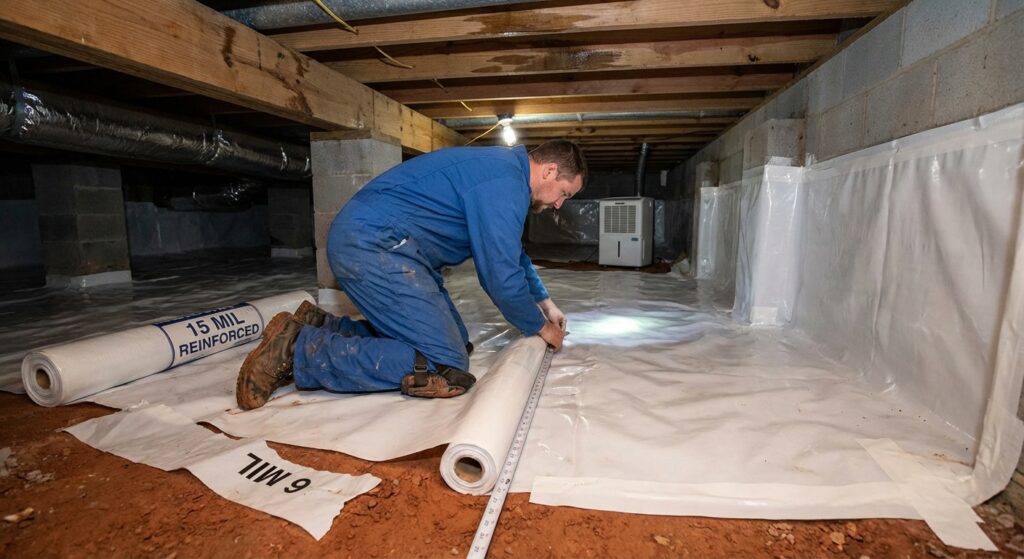
When someone says “6-mil” or “12-mil,” they’re talking about the thickness of the plastic sheet:
- 6-mil = roughly standard contractor plastic (thin, easy to tear).
- 10–12 mil = noticeably tougher, usually reinforced with fiber mesh.
- 15–20 mil = thick, durable, hard to rip even if you try.
The problem is, two different products can both say “12-mil” and feel very different. Some are reinforced; some are not. Some are meant for crawl spaces; some are meant for temporary covers on job sites.
2. What Charlotte Homes Actually Deal With
In Charlotte and surrounding areas like Matthews, Concord, Gastonia, and even up toward Lake Norman, crawl spaces deal with:
- High humidity for a big chunk of the year.
- Clay soil that holds moisture.
- Occasional standing water after big storms.
- Technicians and homeowners crawling around for HVAC, plumbing, and wiring.
Thin plastic + all of that = holes, tape seams lifting, and that “encapsulation” not really encapsulating anything.
Here’s the Part No One Talks About
A lot of folks focus only on the number: “Is it 10-mil or 20-mil?” But the real question is: how is it being used under your house?
When I do a crawl space inspection in Charlotte NC, I’m looking for:
- Is the barrier sealed to the walls and piers?
- Is it taped at seams with quality tape?
- Is it run up the walls high enough?
- Is there a drainage or sump solution if water comes in?
- Is the barrier thick enough for people to crawl on it without destroying it in a year?
You can have 20-mil plastic tossed down with no sealing and still end up with mold and musty smells. You can also have 10–12 mil, installed correctly, and be in great shape.
So What’s a Reasonable Thickness for Encapsulation Here?
I don’t know everything, but after seeing a lot of crawl spaces from Charlotte down to Rock Hill and over toward Spartanburg, here’s the pattern that keeps showing up.
-
6-mil
OK for basic ground cover, not for a real encapsulation you want to last 10–20 years. Tears too easily when people crawl on it. -
8–10 mil reinforced
A decent middle ground for low-traffic crawl spaces, especially smaller homes where folks don’t have to move around a lot underneath. -
12–15 mil reinforced
What I’d call the “sweet spot” for most Charlotte NC encapsulation projects. Tough, good for regular access, and still cost-effective. -
20 mil reinforced
Great for high-traffic or very wet crawl spaces, or if you just want the “I don’t want to think about this again” option.
So for most homes in this area, a lot of pros aim for around 12–15 mil reinforced as the best vapor barrier for crawl space NC weather and soil conditions.
The Actual “Requirement” vs. What’s Smart
Building codes often mention a minimum 6-mil vapor retarder for the ground in vented crawl spaces. That’s the basic box-checker.
But when you’re doing a full encapsulation (sealed vents, barrier up the walls, possibly dehumidifier, maybe drainage), many installers and building science folks recommend:
- Minimum: 10-mil reinforced on the floor.
- Better: 12–15 mil reinforced on the floor and piers.
- High-end: 15–20 mil reinforced in high-traffic or very damp areas.
So, the vapor barrier thickness requirement for Charlotte NC encapsulation isn’t just about passing inspection. It’s about holding up to real life under your home for a long time.
A Little Insider Insight
Here’s what I see over and over again during a crawl space inspection in Charlotte NC:
- Barriers that are technically “thick enough” but full of holes around piers.
- Seams that were taped once and now are peeling open like an old sticker.
- Plastic that stops a few inches from the wall instead of being sealed up it.
- HVAC techs cutting the barrier to run a new line and never sealing it back.
That’s where thickness plus good install really matters. You want something durable enough that a knee, a tool, or a misplaced crawl won’t wreck the whole system.
A Quick Example
Let me tell you about a house in Huntersville. We’ll call the owner Mike.
Mike called because his floors felt bouncy and his house smelled musty, especially after rain. He’d already “had it done” three years earlier — someone put down a white vapor barrier and labeled it an encapsulation.
When I slid in, here’s what I found:
- Thin, 6-mil plastic on the floor.
- Just taped seams, no real mechanical fastening to the walls.
- Tears all around the main access path where HVAC techs had crawled.
- Moisture readings still high on joists. Mold spots starting.
Long story short, the material and the install didn’t match what Mike’s crawl space needed.
We replaced it with a 12-mil reinforced barrier, fully sealed up the foundation walls and around the piers, added some drainage at a low point, and tied it in with a dehumidifier.
I checked back a few months later (just to satisfy my own curiosity, honestly), and his joist moisture readings had dropped, the smell was gone, and Mike could actually crawl in there without worrying about ripping anything.
Let’s Make This Simple
If you’re trying to decide what to do next, here are some quick guardrails.
Questions to Ask Any Installer
- “What thickness are you using, and is it reinforced?”
- “Is this product actually designed for crawl space encapsulation?”
- “How do you seal seams, piers, and walls?”
- “What happens if it tears — do you warranty that?”
- “Can I see a sample of the actual barrier you’ll use?”
Red Flags to Watch For
- Only 6-mil for a full encapsulation quote with no explanation.
- No mention of sealing walls or piers, just “covering the dirt.”
- No talk of drainage in a crawl that clearly gets water.
- They can’t tell you the brand, thickness, or spec of the material.
What I Didn’t Expect
Something I keep seeing in Charlotte, Greenville, and even up in Greensboro is homeowners thinking more expensive always means thicker. Funny enough, I’ve seen high-priced jobs using thin, non-reinforced plastic that I wouldn’t want under my own house.
Price doesn’t always equal quality. The actual product and the way it’s installed do.
If You Only Remember One Thing…
For most homes around here, the best vapor barrier for crawl space NC conditions is usually a reinforced 12–15 mil product, installed well, sealed to the walls and piers, and paired with a plan for water and humidity.
That meets the spirit of the vapor barrier thickness requirement for Charlotte NC encapsulation, not just the letter of minimum code.
What You Can Do Next
Here’s a simple plan:
-
Take a quick look.
If you’re able, pop the crawl door and take a flashlight. Does the plastic look thin and flimsy? Are there tears or seams popped open? -
Write down what you see.
Thickness guess, color, any rips, any standing water, musty smell. Doesn’t have to be perfect. Just notes. - Schedule a crawl space inspection in Charlotte NC with someone who will actually show you pictures and readings, not just a quote number.
- Ask direct questions about thickness and install using the list above. Make them talk about their material.
-
Start where you are.
If doing the full encapsulation all at once feels like too much, at least plan for the right material and sealing method when you do move forward.
If this all feels a bit overwhelming, that’s normal. You’re not crawling under houses every day. Start with one step: get eyes on what’s actually going on under your home, and make sure whoever you hire is using material that can survive real life, not just pass a quick glance.