I was grabbing coffee with a friend in Spartanburg last week, and we got on the topic of home expenses. It’s January, so naturally, the latest heating bill came up. He mentioned his bill was way higher than he expected, even with the cold snaps we’ve been having. He’d sealed his windows, checked his attic insulation—the usual suspects. But he was still stumped.
“Did you ever check your crawl space?” I asked. The look on his face told me everything. It’s the one part of the house everyone loves to ignore. But if you’re wondering why is my energy bill high due to the crawl space in your Charlotte NC home, that forgotten space under your feet is almost always the secret culprit.
The Part No One Talks About
So, how can a dark, dusty space you never enter actually make your HVAC system work overtime? It’s simpler than you’d think. Most older homes in the Charlotte area have vented crawl spaces. The original idea was that vents would let moisture out. We now know it does the exact opposite—it lets humid summer air and frigid winter air right in.
Here’s what’s really happening:
- In the Winter: Cold, damp air seeps into your crawl space through those vents. That cold air makes your floors ice-cold. Your heating system has to fight against that constant cold seeping up from below, so it runs longer and harder to keep you comfortable.
- In the Summer: The same thing happens, but in reverse. Hot, humid Charlotte air gets sucked into the crawl space, bringing moisture with it. Your air conditioner now has to cool your house *and* battle the extra heat and humidity rising from the floor.
It’s a year-round energy drain. Think of it like leaving a window wide open on the bottom floor of your house, 24/7. Would you ever do that? Of course not!
So, What’s the Real Reason for a High Energy Bill from Your Crawl Space?
It boils down to air leakage and poor insulation. That unconditioned air from your drafty crawl space doesn’t just stay down there. Through a process called the “stack effect,” air naturally flows from the bottom of your house to the top. This means the nasty, damp, and temperature-extreme air from your crawl space is constantly being pulled up into your living areas.
This affects more than just your wallet. That same air can carry mold spores, dust mite allergens, and musty odors right into your home, which can be a real headache for anyone with allergies or asthma.
A Quick Example
We worked with a homeowner named Sarah over in the Ballantyne area a while back. She was meticulous about her home but couldn’t figure out why her upstairs was always comfortable while her main floor felt drafty and her Duke Energy bill was creeping up every month. She thought her HVAC was failing.
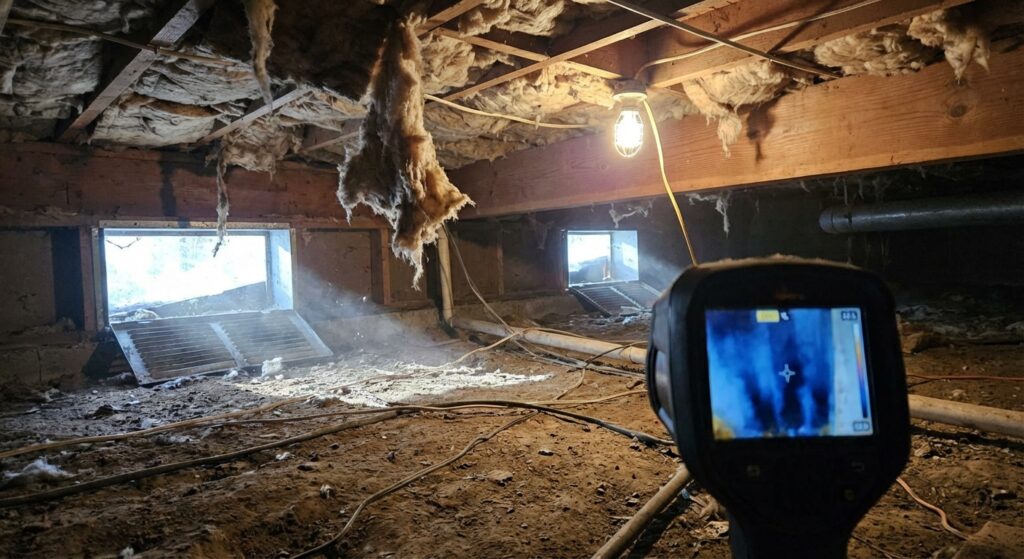
We took one look in her crawl space and found the problem. The old fiberglass insulation was falling down, there was moisture everywhere, and you could feel a breeze coming through the vents. Long story short, we sealed off the vents, put in a vapor barrier, and properly insulated the space. Two months later, she emailed us a screenshot of her energy bill. It had dropped by nearly 25%. She said the biggest difference, though, was that her floors weren’t freezing in the morning anymore.
What You Can Do Next
If this story sounds a little too familiar, you don’t have to just accept high energy bills as a fact of life in Charlotte. The fix often lies in transforming that open, vented space into a closed, conditioned one.
This usually involves a combination of:
- Vapor Barriers: Covering the ground to stop moisture from evaporating into the space.
- Vent Sealing: Closing off the outside world to stop the flow of unconditioned air.
- Crawl Space Insulation: Insulating the foundation walls instead of the floor joists to keep the space temperate.
I know, looking into your own crawl space can be a daunting task (and honestly, who really wants to do it?). If you suspect your high energy bill is from your crawl space, the easiest first step is to have a professional take a look. Here at Charlotte Crawlspace Solutions, we can quickly identify if your crawl space is the energy vampire draining your bank account and give you a clear plan to fix it. It might be the best investment you make in your home this year.