Let’s Dive In
A homeowner in south Charlotte told me this once over sweet tea at a barbecue place off South Blvd: “The crawl space company said I needed a super thick vapor barrier. The other guy said I was being upsold. I just want to know what’s actually right.”
If you’ve had two different quotes for crawl space encapsulation and they didn’t even agree on the plastic thickness… yeah, that’s confusing.
So let’s talk about the vapor barrier thickness requirement for Charlotte NC encapsulation in normal people language. No fancy code books. Just what actually works in our humid, mixed-climate area.
Let’s Break This Down
First big truth: there isn’t one magic number written in stone just for Charlotte. Building code gives minimums, and then there’s what actually holds up in real crawl spaces with real kids, plumbers, and HVAC techs climbing around in them.
Around here, you’ll usually hear three thicknesses:
- 6 mil – thin, basic plastic
- 10 mil – moderate strength
- 12–20 mil – heavy-duty vapor barrier made for encapsulation
On paper, 6 mil seems “good enough.” But once you see how it behaves in a real Charlotte crawl space after a couple of years… it’s a different story.
Here’s the Truth About Thickness
Let’s keep it simple:
- Building code minimum is usually around 6 mil polyethylene as a ground cover.
- That minimum is meant for basic moisture control, not a full encapsulation with long-term durability.
- Most solid encapsulation setups in North Carolina use at least 10 mil, and often 12–20 mil on the floor.
The code doesn’t say, “Use 12 mil in Charlotte or else.” It just says, “You need a vapor retarder on the ground.” The rest is about long-term performance, not just passing an inspection one time.
The Part No One Talks About
Vapor barrier thickness isn’t just about blocking moisture. Pretty much any plastic sheet will slow water vapor. The real problem is:
- Foot traffic – HVAC techs, electricians, plumbers, pest control… they all crawl on it.
- Sharp stuff – nails, rocks, broken brick, wood splinters, old construction debris.
- Time – thin plastic gets brittle, tears, and seams pull apart.
That’s why the best vapor barrier for crawl space NC homes usually isn’t the thinnest one that technically meets the rule book. It’s the one that holds up to getting beat up for 10–15 years.
So What Actually Works in Charlotte?
For houses around Charlotte, Gastonia, Concord, up to Statesville and down toward Rock Hill, here’s what I typically see work long-term:
-
Floor vapor barrier:
- Minimum I’d feel good about: 10 mil reinforced liner
- What really lasts: 12–20 mil reinforced, especially if people will be in the crawl space more than a couple times a year
-
Walls and piers:
- Usually 10+ mil attached to the foundation walls and wrapped around piers
-
Taped seams:
- Use seam tape designed for the liner, not duct tape from a big box store
Can you use thinner plastic? Sure. But if you’re investing in full encapsulation, it’s kind of like buying a new roof and going with the cheapest shingles you can find — you’ll save a bit now and pay more later.
Let’s Clear Something Up
There’s a lot of noise online about “If it’s not 20 mil, it’s junk” or “6 mil is all you ever need.” Real talk: both extremes are off.
Here’s a more honest middle ground:
- 6 mil: Fine for a basic ground cover, not great for full encapsulation where the crawl space is treated like part of the home.
- 10 mil: Good balance for many homes, especially if access is limited and people rarely crawl in there.
- 12–20 mil: Best for durability, high-traffic crawls, or if you’re already dealing with serious moisture or mold issues.
Why Thickness Isn’t the Only Thing
You can have 20 mil plastic and still have a damp, musty crawl space if the rest is done wrong. Thickness is just one piece.
Here’s what matters just as much:
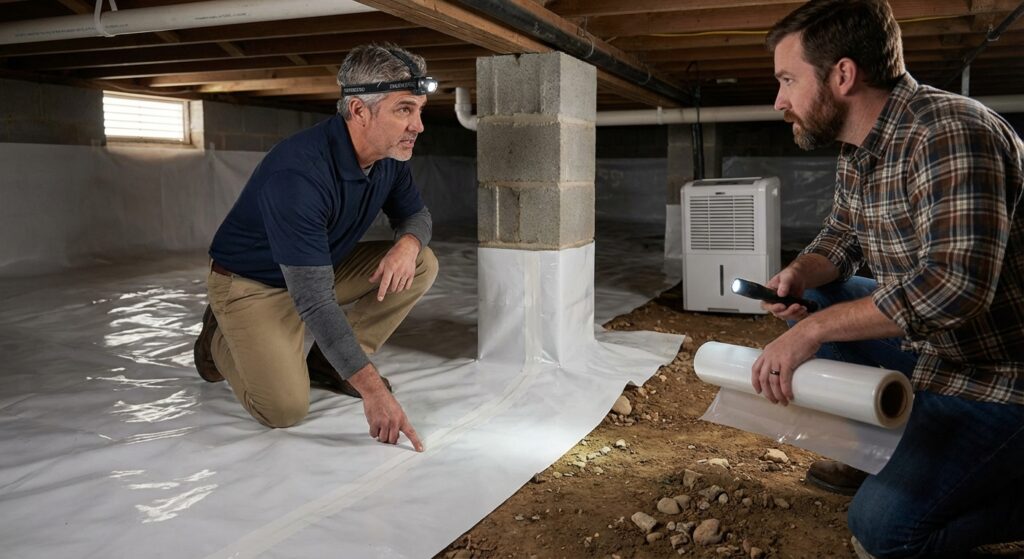
- Seams taped and overlapped at least 6–12 inches
- Sealed to walls and piers (not just loose on the floor)
- Termite inspection gap left at the top of the foundation wall where required
- Proper drainage and a sump if you get standing water
- Dehumidifier or other humidity control in the encapsulated space
I don’t know everything, but I’ve seen enough crawl spaces in Charlotte, Huntersville, and even over in Greenville, SC to tell you: great material with bad installation still fails.
A Quick Reality Check
Before you even get to thickness, a solid crawl space inspection in Charlotte NC is huge. You need to know:
- Is there active water coming in?
- Are there foundation cracks or settlement?
- Any mold growth on joists or subfloor?
- What’s the current humidity down there?
Thickness should match the condition of your space and how often it’ll be used. Not just which roll of plastic was on sale.
A Real-Life Moment
Let me tell you about Chris, a homeowner near Ballantyne.
He’d had a “budget” vapor barrier put in about 5 years earlier. It was 6 mil, no wall coverage, just laid on the ground with a few rocks tossed on top to “hold it down.” He called because his floors felt cold and his daughter’s allergies were flaring up.
When we crawled under the house, here’s what we found:
- Plastic torn in a dozen spots
- Moist soil exposed in several areas
- No sealing to the walls or piers
- Insulation hanging down and damp joists
We ended up:
- Cleaning out the old torn liner
- Installing a 12 mil reinforced liner on the floor
- Running the liner up the walls and around piers
- Adding a dehumidifier and sealing vents
Was 12 mil more expensive than another roll of 6 mil? Yep. But a year later, Chris told me at a coffee shop in Matthews that the space still looked like we’d just finished the job. No tears, no musty smell, and his HVAC tech actually thanked him because it was easier to work in.
Let’s Make This Simple
Here’s a quick way to match thickness to your situation:
| Your Situation | Suggested Floor Thickness |
|---|---|
| Basic moisture control, you rarely enter the crawl space | 10 mil reinforced |
| Full encapsulation, occasional access for service | 12–15 mil reinforced |
| High traffic (lots of trades, storage use, or very rough floor) | 15–20 mil reinforced |
One little tangent here: if you’ve got a really rocky, uneven crawl with old debris everywhere, I like to see folks invest in the thicker side. It’s like kneepads for your vapor barrier (and your knees, honestly).
What You Can Do Next
If you’re still unsure what vapor barrier thickness requirement for Charlotte NC encapsulation makes sense for your home, here’s a simple game plan:
- Step 1: Get a detailed crawl inspection with photos, not just a “you’ve got moisture” comment.
- Step 2: Ask each company what thickness they’re using on the floor and walls, and why.
- Step 3: Have them show you a sample of the liner so you can feel the difference.
- Step 4: Compare not just price, but materials, thickness, and how they’re sealing everything.
If a contractor can’t explain their choice in plain English, that’s a red flag.
If You Only Remember One Thing…
Thicker isn’t always about “fancier.” It’s about how long you want your crawl space encapsulation to last before you’re paying someone to crawl back in there and fix tears and gaps.
Start with a good inspection, choose a vapor barrier that fits how your crawl space will actually be used, and don’t be afraid to ask very direct questions about mil thickness, reinforcement, and installation details.
And if all of this still feels like a lot, that’s okay — just start by crawling (or having someone crawl) under your home and taking some pictures. Once you see what’s really going on, the right choice for your home here in North Carolina gets a whole lot clearer.