I was grabbing lunch with a friend in Spartanburg the other day, and he was telling me about his recent home project—a full crawl space encapsulation. He was so relieved. “Finally,” he said, “no more musty smells, no more worrying about moisture.” But a few weeks later, he called me, completely frustrated. “It still smells weird in the laundry room, right above the back corner of the house. I thought we fixed this!”
If you’ve ever felt that, you are definitely not alone. You invested in encapsulation, you have the fancy dehumidifier humming away, but certain spots just don’t feel… right. They might feel humid, smell musty, or just seem stagnant. You’ve just discovered what we in the business call “dead pockets.”
Let’s Break This Down: What’s a Dead Pocket?
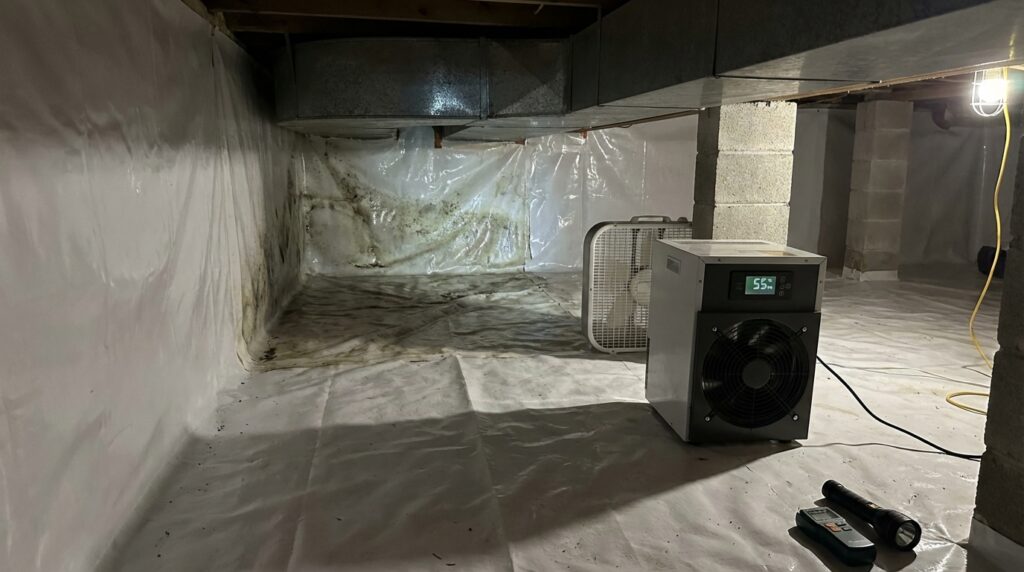
Think of your crawl space like a big, oddly shaped room. When you put a dehumidifier in it, you’re trying to circulate the air and pull moisture out of the *entire* space. But sometimes, because of the shape of the foundation, support pillars, or even HVAC ductwork, some corners get cut off from the airflow.
These isolated areas become “dead pockets.” Air doesn’t move there. The humid air just sits, and the dehumidifier, no matter how hard it works, can’t reach it. So, while 90% of your crawl space is perfectly dry and healthy, that one corner is quietly letting moisture build up. This is a common reason we get calls about why are there dead pockets in my encapsulated charlotte crawl space from homeowners who thought their problems were over.
The Usual Suspects Behind Poor Airflow
I’m not a magician, but after seeing hundreds of crawl spaces around the Carolinas, the issue usually boils down to a few key things. It’s rarely a single catastrophic failure; it’s often something small that was overlooked.
- Dehumidifier Placement is Everything: Often, the unit is just in the wrong spot. It might be tucked away in a corner or placed right next to a return vent, creating a short circuit where it just keeps drying the same air over and over.
- Your Crawl Space Has a Weird Layout: Homes in our area, especially older ones, can have L-shaped foundations or a maze of support piers. These act like walls, blocking airflow and creating natural dead zones.
- Not Enough Oomph: The dehumidifier might be too small for the square footage it’s trying to cover. It’s running constantly but just can’t keep up with the total volume of air.
- No Circulation Help: Sometimes, a dehumidifier needs a little help. In larger or more complex crawl spaces, a simple box fan or a small directional fan is needed to keep the air moving and push it toward the dehumidifier.
A Quick Real-Life Example
We got a call from a homeowner in Matthews, NC, with this exact problem. She had a brand-new encapsulation, but the corner under her master bedroom closet always had a faint musty smell. When our team at Greenserve went down to take a look, we saw the problem immediately.
Her dehumidifier was a great unit, but it was placed at the far end of a long, rectangular crawl space. A huge HVAC trunk line ran down the middle, essentially splitting the space in two. The air on one side was bone dry; the other side (under her closet) wasn’t getting any circulation at all. The fix was simple. We didn’t even need a new unit. We just added one small, low-voltage fan to push air from the dead pocket toward the dehumidifier. Two days later, she called to say the smell was completely gone.
So, What Can You Do Next?
First, don’t panic. This is a fixable problem. You can start by just taking a look at your dehumidifier. Is it in a central location? Does it seem like air can move freely around it? Sometimes a small adjustment can make a world of difference. You could even try adjusting the settings; a common question we get is what temperature should crawl space dehumidifier be set at in Charlotte, and the sweet spot is usually between 50-60% relative humidity.
But let’s be honest, crawling around trying to diagnose airflow is not most people’s idea of a fun Saturday. (It’s ours, but we’re a little weird like that).
If you’re still wrestling with why there are dead pockets in your encapsulated Charlotte crawl space, it might be time for a professional set of eyes. A quick crawl space inspection in Charlotte, NC, can pinpoint exactly where the airflow is breaking down. If you think that’s your situation, give our team at Greenserve a shout. We can help you get that final 10% of your crawl space just as dry and healthy as the rest.