Let’s Get Honest for a Second
I was sitting with a homeowner in south Charlotte not long ago, at their kitchen table, iced tea sweating all over my notepad. They’d just had a dehumidifier installed in their crawl space and asked me:
“So… what temperature should my crawl space dehumidifier be set at? The installer said it’s ‘already set up,’ but that doesn’t tell me anything.”
If you’ve wondered the same thing, you’re not alone. The mix of heat, humidity, and red clay around Charlotte makes crawl spaces weird. And when you throw in a dehumidifier that has temp and humidity numbers on the screen, it’s easy to overthink it.
So let’s talk about what temperature you actually need to worry about, and what you can ignore.
Let’s Clear Something Up
Before we dive into numbers, here’s the first big thing:
your main setting is humidity, not temperature.
Most crawl space dehumidifiers in Charlotte don’t “cool” the space the way your AC cools your living room. They pull moisture out of the air. Temperature matters, but mostly as a safety or operating limit.
When people search “what temperature should crawl space dehumidifier be set charlotte,” what they really want is:
- What should the humidity be?
- What temp range is okay for the unit?
- How do I keep from burning the thing up or wasting money?
Let’s Make This Simple
I don’t know everything, but here’s the simple baseline that works for most Charlotte crawl spaces:
- Humidity (the important one): Set between 45–55% relative humidity.
- Temperature (what most units “care” about): They typically operate best between about 45°F and 90°F.
So if your dehumidifier has:
- Only a humidity setting: Set it around 50% and you’re good.
- Humidity + a “defrost” or “low temp” mode: Leave the temp/defrost on auto and focus on that 45–55% humidity range.
In the Charlotte area, including places like Gastonia, Concord, and up toward Lake Norman, most crawl spaces end up somewhere in the 60–75°F range in summer anyway. The dehumidifier isn’t trying to hit a temp; it’s trying to keep things dry enough that mold can’t party down there.
The Part No One Talks About
Here’s what really matters more than a perfect temperature number:
- The crawl space should be sealed up properly. If outside air is pouring in, your dehumidifier will run nonstop and still struggle.
- Vapor barrier should be solid. In Charlotte’s clay soil, ground moisture is a big deal, especially after heavy rain.
- Vents closed or sealed. Open vents + dehumidifier = like running your AC with the windows open.
- Unit the right size. Undersized units will never “catch up” in a damp, leaky space.
That’s why a lot of folks start with a crawl space inspection in Charlotte NC first, before they even mess with settings. You want to know if the space is actually ready for a dehumidifier to do its job.
So Here’s the Strange Part
Some dehumidifiers let you set a target temperature, and that throws people off.
For crawl spaces, here’s a simple approach:
- If the manual has a suggested temp range: Stick with that. A lot of units are happiest somewhere between 60–80°F.
- If there’s a “minimum operating temp”: Don’t expect it to run well below that, especially in a cold snap.
- If you never see a temp option at all: Good. You don’t need to worry about it.
In our climate, you’re mostly protecting against summer and shoulder-season humidity, not winter. Winters around Charlotte are usually mild enough that the dehumidifier just cycles less often.
A Quick Reality Check
Let’s talk numbers in plain language:
- Above 60% humidity for long periods = mold risk climbs.
- 45–55% humidity = sweet spot for crawl space health and wood protection.
- Below 40% humidity for long periods = usually unnecessary and may just run up your power bill.
So if you’re staring at your dehumidifier panel in your crawl space with a flashlight thinking, “Do I set it at 35% to be safe?” — I’d say no. You don’t need to dry it out like Arizona.
A Little Insider Insight
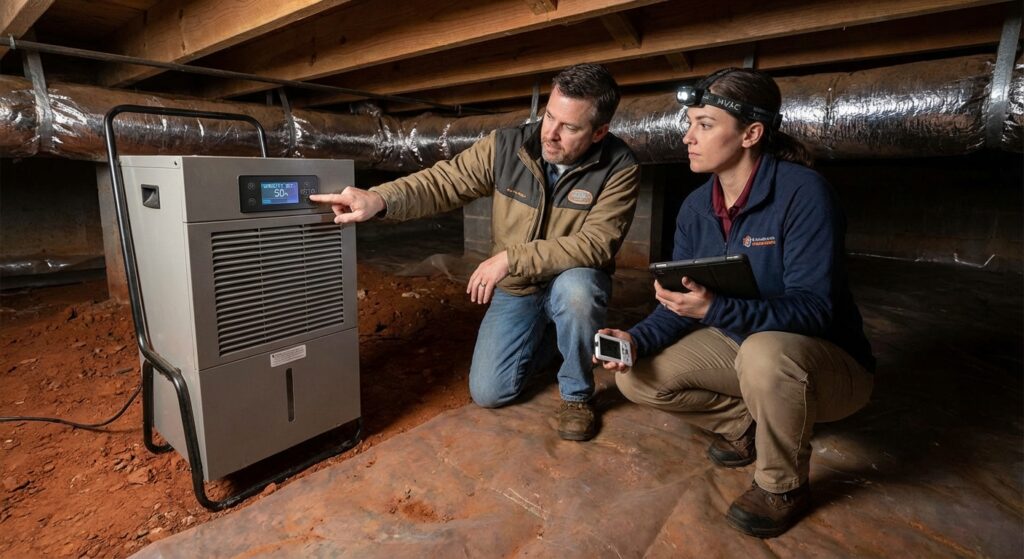
During a crawl space inspection in Charlotte NC, here’s what I usually check when someone already has a dehumidifier installed:
- The humidity reading on the unit vs. a handheld meter (sometimes they’re off).
- Whether the intake and exhaust of the unit are blocked by plastic, ducts, or stored junk.
- If the drain line is clear and sloped properly.
- How often the unit seems to be cycling.
And here’s the twist: lots of problems people blame on “wrong settings” are actually from air leaks, standing water, or bad drainage, not from the dehumidifier itself.
A Story You’ll Relate To
Earlier this year, I met a homeowner in Matthews — we’ll call him Mark — who was convinced his dehumidifier was set wrong.
He told me, “I set it at 40%, the thing runs all the time, the meter still says 60%, and my power bill jumped like 60 bucks.”
We crawled under the house (always the fun part) and here’s what we found:
- Vents were wide open.
- No real vapor barrier, just some thin plastic thrown down in spots.
- One section of duct leaking conditioned air into the crawl space.
- Dehumidifier shoved in a corner with poor air circulation.
We didn’t change his dehumidifier brand or model. We:
- Sealed the vents.
- Installed a thicker vapor barrier and taped seams.
- Repaired the duct leak.
- Moved the dehumidifier to a better central location.
- Set it to 50% humidity and left the temp on auto.
Two weeks later, he texts: “Crawl space is steady at 50–52%, the thing actually shuts off now, and my power bill dropped again.”
The setting wasn’t the villain. The crawl space setup was.
Let’s Break This Down (Step-by-Step)
If you’re standing in your crawl space right now wondering what to do, here’s a simple checklist:
-
Find your dehumidifier manual.
If you don’t have it, Google the brand and model number. Look for:- Recommended humidity range
- Operating temperature range
- Any “crawl space” or “basement” notes
-
Set humidity to 50% (or in the 45–55% range).
That’s a solid Charlotte target that balances mold prevention and energy use. -
Leave temperature on auto, if possible.
If it forces a number, choose something in the 60–75°F range and don’t stress over it. -
Check the space, not just the screen.
Use a small digital hygrometer (you can grab one at a hardware store or online for $10–$20) and place it in another area of the crawl space. Compare:- Humidity on the dehumidifier
- Humidity on your separate meter
-
Look for the “obvious leaks.”
While you’re down there, take a quick look:- Are vents open?
- Is there bare dirt with no vapor barrier?
- Do you see water stains or pooling?
If so, no setting will completely fix that.
The Root of the Problem
A lot of Charlotte homeowners call asking for crawl space repair near me charlotte because they’re seeing:
- Musty smells on the first floor
- High indoor humidity even when the AC is running
- Buckling hardwood floors
- Condensation on ducts or pipes
And yes, the dehumidifier settings matter. But they’re usually the last step, not the first one.
It reminded me of someone trying to fix a roof leak by buying a nicer bucket. The bucket (dehumidifier) is fine — the roof (crawl space setup) is what needs love.
Here’s the Big Takeaway
If you only remember one thing from this, let it be this:
focus on 45–55% humidity, and make sure your crawl space is sealed and drained well enough for your dehumidifier to actually reach that level.
The question “what temperature should crawl space dehumidifier be set charlotte” is really just:
“How do I keep my crawl space from growing mold and wrecking my house?”
What You Can Do Next
Here’s an easy next step list:
- Check your current humidity setting — aim for 50%.
- Make sure your unit’s temp range matches our climate (most do just fine here).
- Grab a cheap hygrometer and compare readings in a couple spots.
- If anything feels off — constant dampness, bad smells, standing water — get a professional set of eyes on it.
If you’re in or around Charlotte and thinking, “This is more than I want to crawl around and figure out myself,” scheduling a crawl space inspection in Charlotte NC isn’t a bad move. That way you’ll know if the problem is your settings… or if it’s the space itself.
Start with the humidity setting, give it a week or two, and see how things change. And if you’re still not sure what your crawl space is trying to tell you, you don’t have to figure it out alone.