Why Your Crawl Space Keeps Filling With Water Every Storm
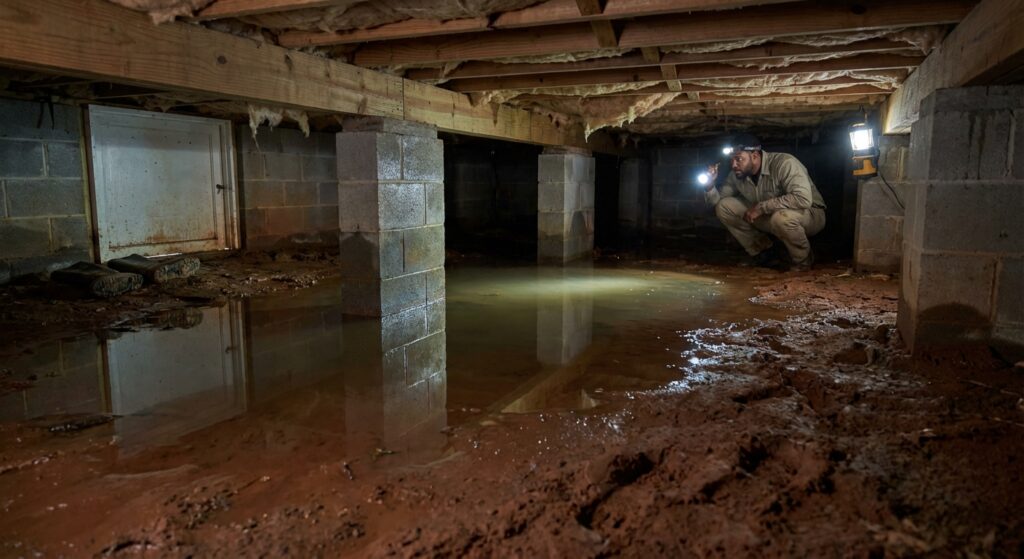
A few weeks ago I was in Charlotte, grabbing lunch near SouthPark, when a homeowner pulled up a photo on their phone and slid it across the table. Standing water. Puddles all through the crawl space. Concrete block piers reflecting like a mirror.
Their question was simple: “Why does my crawl space look like a swamp every time it rains?”
If you’ve got crawl space water pooling around the foundation in Charlotte clay soil, you’re not alone. That red clay we all love to hate has some quirks, and your house is feeling them.
Let’s Break This Down
First, what’s actually happening under there?
Charlotte’s heavy clay soil holds water like a sponge. When we get a big storm:
- The clay around your foundation soaks up water
- It swells and gets heavy and sticky
- Water looks for the lowest, easiest path to drain
- Surprise: that “lowest, easiest” spot is often your crawl space
That water then just sits there. It can’t soak in fast enough, and there’s nowhere for it to go. So you get pooling, muddy spots, and sometimes actual little “lakes” under your home.
Why should you care? Because that standing water can:
- Rot or soften wood joists and beams
- Feed mold and mildew (and that musty smell you notice)
- Attract pests like termites and roaches
- Raise humidity inside the house
- Cause insulation to sag and fall
Here’s the Truth About Charlotte Clay Soil
Let’s get honest for a second. Clay is stubborn.
It doesn’t drain like sandy coastal soil. It doesn’t behave like nice loam you find in some older Asheville neighborhoods. Clay swells when it’s wet and shrinks when it’s dry. That movement puts pressure on your foundation and changes where water flows.
Around Charlotte, that means:
- Water tends to run along the top of the clay instead of soaking down quickly
- Downspouts dumping too close to the house basically aim water straight at your crawl space
- Low spots in the yard become funnels, feeding directly toward your foundation
So if you’re seeing puddles under your home, it’s usually not “one big thing.” It’s a bunch of small things adding up.
Let’s Clear Something Up: It’s Not Always a “Foundation Failure”
A lot of people panic and jump straight to worst-case thoughts like, “My foundation is ruined.”
Sometimes there is structural damage, but often the real root problem is:
- Poor grading (yard slopes toward the house)
- Missing or clogged gutters
- Downspouts ending right at the foundation
- No drain system in the crawl space
- No vapor barrier or a torn, thin plastic sheet
Long story short: water is being allowed to hang out under your home. The goal is to stop that.
What You Can Do Next (Outside First, Then Inside)
When you’re dealing with crawl space water pooling around foundation in Charlotte clay soil, you always want to start with the simple outside fixes. If you skip this step and only work inside the crawl space, you’re fighting the same battle every storm.
1. Check Your Gutters and Downspouts
- Make sure every roof edge has a gutter (no big gaps)
- Clean leaves and shingle grit out twice a year
- Add downspout extensions so water exits 6–10 feet from the foundation
- Don’t let splash blocks dump water into low spots near vents
This seems basic, but I’ve seen crawl spaces with multiple inches of water just because of two bad downspouts.
2. Fix Grading Around the House
Walk around your house after a rain. Where does water sit?
- Soil should slope away from the foundation at least 6 inches over the first 6–10 feet
- Fill low spots that collect puddles near foundation walls
- Avoid piling mulch above the bottom of your siding or brick
With clay, sometimes you need to bring in soil and gently reshape the yard. It’s not glamorous, but it works.
3. Look for Surface Water “Highways”
In some Charlotte yards, the driveway, sidewalk, and landscaping all team up to push water toward the house.
- Watch how water runs off the driveway in a heavy rain
- Check if landscape edging traps water against the foundation
- Consider shallow swales (small grass ditches) to redirect runoff
4. Now Peek Inside: Crawl Space Inspection Basics
If you can safely get under your house, a quick crawl space inspection in Charlotte NC can tell you a lot. Bring a flashlight and wear a mask if you have one.
While you’re under there, look for:
- Standing water or mud lines on piers and walls
- Dark staining on wood joists or subfloor
- Mold or mildew on insulation or wood
- Insulation sagging or falling down
- Smells that hit you as soon as you open the access door
If anything feels off or unsafe, back out and call a pro. No crawl space is worth getting hurt over.
5. Interior Drainage and Sump Pump (When You Need More Muscle)
If water is continuously entering your crawl space, you may need:
- A perimeter drain system inside the crawl space
- A sump pit and pump to send water away from the house
- Good discharge piping, run well away from the foundation
This is usually where homeowners start typing “crawl space repair near me charlotte” and honestly, that’s fair. Cutting trenches, installing stone and pipe, and wiring a pump isn’t a DIY job for most people.
6. Don’t Forget the Vapor Barrier and Humidity Control
Standing water is problem one. High humidity is problem two.
Once the water is managed:
- Install a quality vapor barrier (thicker plastic, sealed at seams)
- Consider encapsulation if your crawl space is always damp
- Use a dehumidifier rated for crawl spaces when humidity stays high
I don’t know everything, but I can tell you this: a good vapor barrier plus drainage beats “just a fan in the vent” any day in clay soil.
A Real-Life Moment From a Charlotte Crawl Space
Earlier this year, I was out near Steele Creek looking at a 1990s home. The owner, we’ll call her Michelle, told me her floors felt bouncy and her nose was constantly stuffy at home.
Here’s what we found:
- Gutters on the back of the house were clogged solid
- Both downspouts were dumping water right at the back foundation wall
- The backyard sloped toward the house thanks to a patio someone added years ago
- The crawl space had 1–2 inches of water in the back corner after every decent storm
- The plastic on the ground was thin, torn, and not sealed
We didn’t start with some massive, expensive project. The first steps:
- Cleaned and repaired the gutters
- Added 10-foot downspout extensions into the yard
- Regraded a small section so water flowed around the side of the house instead of straight at it
Only after that did a crew install an interior drain and sump in the crawl space, plus a thicker vapor barrier. The wild part is, just fixing the gutters and grading reduced the water by more than half before any pump ever turned on.
A month later, Michelle told me the musty smell was gone and her floors already felt more solid. Not magic. Just water management.
The Part No One Talks About
Something I keep seeing around Charlotte, Matthews, and Huntersville: people assume clay soil is just “how it is” and there’s nothing to be done. So they ignore the crawl space for years.
But here’s the kicker: your crawl space is basically the lungs of your home. A lot of the air you breathe upstairs has passed through there. Wet, moldy crawl space? You’re breathing that in, whether you ever go under there or not.
And get this: many moisture problems that cost thousands later could have been kept small with a couple hundred bucks worth of gutters, extensions, and yard tweaks early on.
If You Only Remember One Thing…
Water under your home is not “just a nuisance.” With Charlotte’s clay soil, it’s a sign the ground and water around your house aren’t being managed right.
The basic order is:
- Fix gutters and downspouts
- Improve grading and surface drainage
- Inspect the crawl space and address standing water
- Add interior drains and a sump pump if needed
- Install a solid vapor barrier and control humidity
That’s how you stop crawl space water pooling around foundation in Charlotte clay soil from turning into rotten wood, mold, and bigger headaches.
What You Can Do Next
Here’s a simple way to start this week:
- Walk your yard after the next rain and note where water stands
- Look up at your gutters and see if any are overflowing
- Open the crawl space door, take a quick sniff, and shine a light around
If anything feels off, that’s when it makes sense to look for crawl space repair near me charlotte and get a professional crawl space inspection in Charlotte NC. Let someone who crawls these spaces every day tell you what’s going on under there.
And if this all feels like a lot, just start with one thing: get the water away from your foundation outside. That single move, done right, can change the entire story under your home.